
Direct Air Capture: The Solution No One Can Afford for A Problem That Doesn't Exist!

The National Center for Energy Analytics (NCEA), where the great Mark Mills serves as Executive Director, issued a report titled “A Cost-Benefit Analysis of Using Direct Air Capture to Remove Atmospheric Carbon” by Jonathan A. Lesser in February. It exposes the fallacies behind removing CO₂ from the atmosphere. It is somewhat lengthy, but I asked Perplexity to summarize:
The Core Conclusion
The report, authored by Jonathan Lesser, Senior Fellow at the National Center for Energy Analytics and President of Continental Economics, delivers a blunt verdict: direct air capture (DAC) of CO₂ cannot effectively remove carbon from the atmosphere in a physically, economically, or environmentally viable way. Despite receiving the largest federal subsidy in the energy space — currently $180 per metric ton under Section 45Q of the U.S. Tax Code — DAC fails on virtually every meaningful metric when subjected to rigorous cost-benefit scrutiny.
What Is DAC and How Does It Work?
DAC systems function like industrial-scale vacuum cleaners, pulling ambient air through contactors to extract CO₂. Two commercial approaches exist: a liquid solvent method using potassium hydroxide (developed by Carbon Engineering) and a solid sorbent method using amine-based filters (developed by Climeworks). Both were founded in 2009 and remain largely confined to demonstration-scale projects. The largest operational facility in the world, Occidental Petroleum’s Stratos plant in the Permian Basin of Texas, is designed to capture 500,000 tonnes of CO₂ annually.
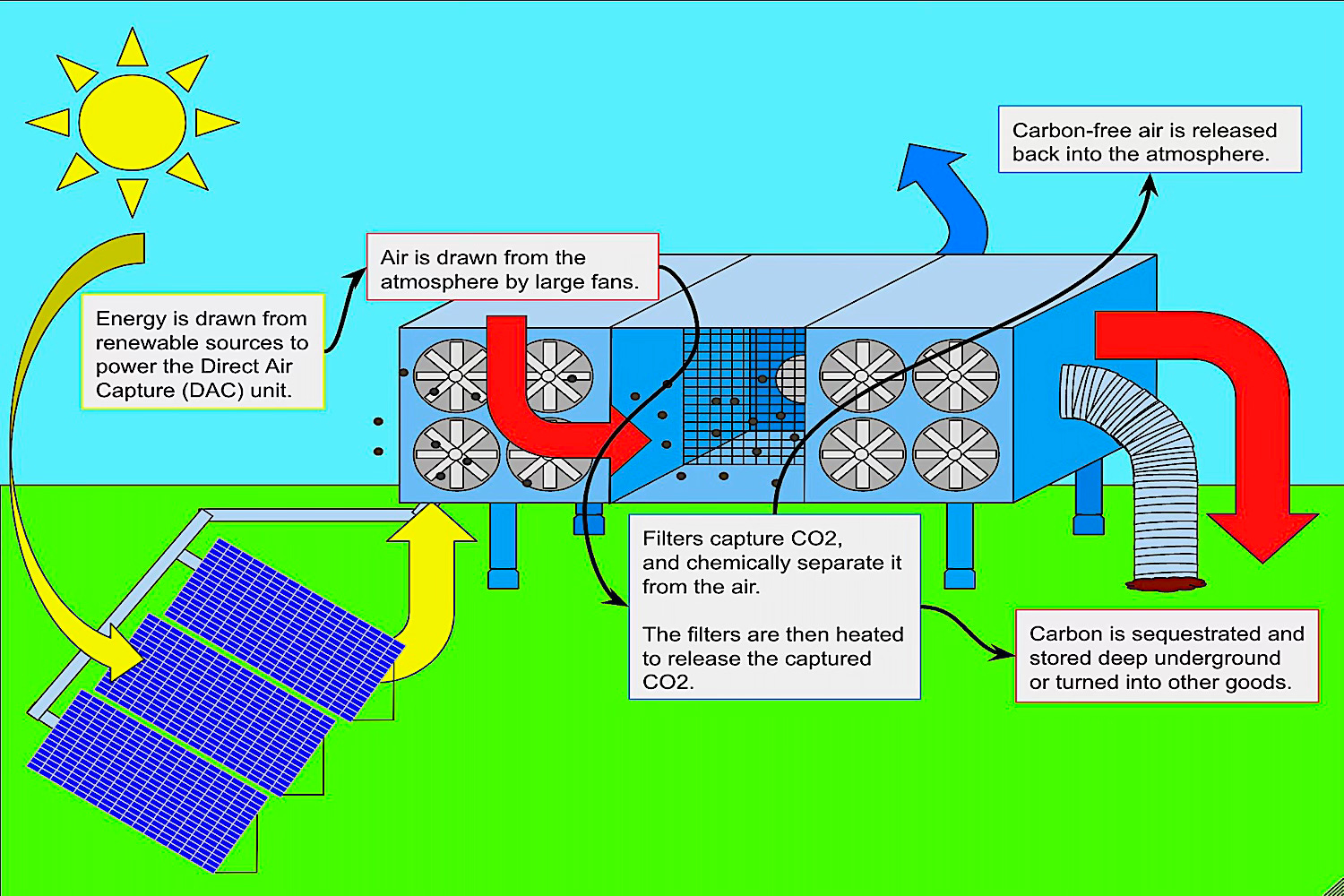
The Energy Problem Is Fundamental
The report’s central objection to DAC is rooted in thermodynamics. Because atmospheric CO₂ is just 425 parts per million — roughly 100 times more dilute than in industrial flue gases — extracting it requires far more energy. The theoretical minimum energy to capture and compress one tonne of atmospheric CO₂ is over 300 kWh/tonne. But real-world published estimates average around 1,820 kWh per tonne — more than two months’ worth of electricity for an average U.S. household, just to capture a single tonne.
Scaling this up to the U.S. Department of Energy’s stated goal of removing 1 billion tonnes (1 Gt) of CO₂ per year would require electricity equivalent to roughly 30% of total U.S. electricity generation. Achieving the DOE’s high-end target of 2 billion tonnes annually would demand electricity approaching 85% of all U.S. electricity generated in 2024 — a figure the report describes as simply unrealistic.
Nuclear or Renewables: Both Are Prohibitive
Since burning fossil fuels to power DAC would negate its purpose, the electricity must come from zero-emissions sources. To capture 1 Gt of CO₂ annually using nuclear power would require building 180 new 1,000-MW nuclear plants — on top of the existing U.S. fleet. The most recently completed U.S. nuclear plant, Georgia Power’s Plant Vogtle (two 1,000-MW reactors), took over a decade to build and cost more than $33 billion — nearly three times its original estimate.
Wind and solar would require even more. Because of their low capacity factors (around 35% for wind, 25% for solar) and inherent intermittency, an equivalent wind/solar/battery system to power 1 Gt of DAC would need 750,000 to over 1 million MW of wind and solar capacity plus an additional 250,000–350,000 MW of battery storage — roughly 10 times current U.S. utility-scale battery capacity. The land required for the wind and solar infrastructure alone would exceed the area of Florida.
The Costs Are Staggering
The total capital and financing costs to power 1 Gt of annual DAC would reach approximately $3.7 trillion using nuclear or $3.9 trillion using wind, solar, and battery storage. Adding the cost of the DAC facilities themselves (estimated at $675 billion to $1.25 trillion for 1,000 facilities), plus operations and maintenance, the per-tonne cost of CO₂ removal would exceed $400/tonne — far above even the EPA’s current social cost of carbon estimate of $210/tonne. For a family of four, full-scale DAC implementation would translate to over $4,000 in annual household costs.
The Climate Impact? Negligible
Perhaps most damning, Lesser demonstrates that even if these costs were somehow absorbed, the climate impact would be nearly unmeasurable. Removing 1 Gt of CO₂ annually would reduce atmospheric CO₂ concentration by just 0.13 parts per million and lower global average temperature by only 0.003°C — a figure more than 40 times smaller than the inherent margin of error in global temperature measurements. Even removing 10 Gt per year would produce a temperature reduction of just 0.3°C.
Underground Storage Risks
The report also raises safety concerns about permanently sequestering captured CO₂ underground. A natural CO₂ release at Lake Nyos, Cameroon, killed over 1,700 people four decades ago, and Lesser sees no scientific basis for assuming that storing billions of tonnes underground carries no similar risk.
The Bottom Line
Lesser concludes that DAC should not be pursued as climate policy. The physics are unfavorable, the economics are ruinous, the infrastructure requirements are implausible, and the resulting climate benefit would be too small to detect. The report calls on policymakers to reject continued federal subsidies for DAC and redirect attention toward energy strategies with measurable real-world impact.
Enough said. This is one of the dumbest ideas to ever come out of the climate cult.
#NationalCenterEnergyAnalytics #NCEA #DAC #DirectAirCapture #CO2

Carbon capture is like shoveling wealth out of our economy into a toilet and flushing. It has zero benefit and makes us all poorer.
Carbon capture and sequestration. Most CO2 capture will be done with energy from fossil fuels, not hydro, nuclear, or geothermal. That will produce more man-made carbon dioxide!! The problem of man-made CO2 being a pollutant does not exist. It is all lies of Al Gore, John Kerry, Michael Mann, Barack Obama, Joe Biden, etc. in the USA, and their counterparts in Europe,, Canada, and Australia. Our politicians at national, state/province and city levels promoting man-made global warming correction policies are totally our of their minds, worse that the Mongols or the Black Plague. Western Civilization has gone amuck.