
Washington State Experience Shows Green Energy Is All About the Grifting and the Bragging and Does Nothing for Which It Was Intended
Guest Post from the Institute for Energy Research.
The Washington State Climate Commitment Act (CCA) was supposed to reduce 8.6 million tons of greenhouse gas emissions over its lifetime. However, due to a clerical error, the state corrected the estimate to 308,000 tons of emissions, or less than 4% of the original number, and less than one-half of 1% of the state’s annual emissions.
The CCA, passed in 2021, raised more than $4.3 billion to support programs that ostensibly reduce the state’s carbon emissions. The act requires businesses that emit greenhouse gases to buy credits to offset the emissions they generate. The data is compiled from more than 3,600 projects from 37 agencies. The Seattle Times reports that the error occurred in the calculation of emissions from eight rebate projects to help electrify homes, purchase new appliances, and assist low-income communities.
Those eight projects were originally expected to cut emissions by 7.5 million tons. Corrected data show the new emission reduction figure to be 78,000 tons, just over 1% of the earlier projection, and raise questions about the veracity of the state’s data.
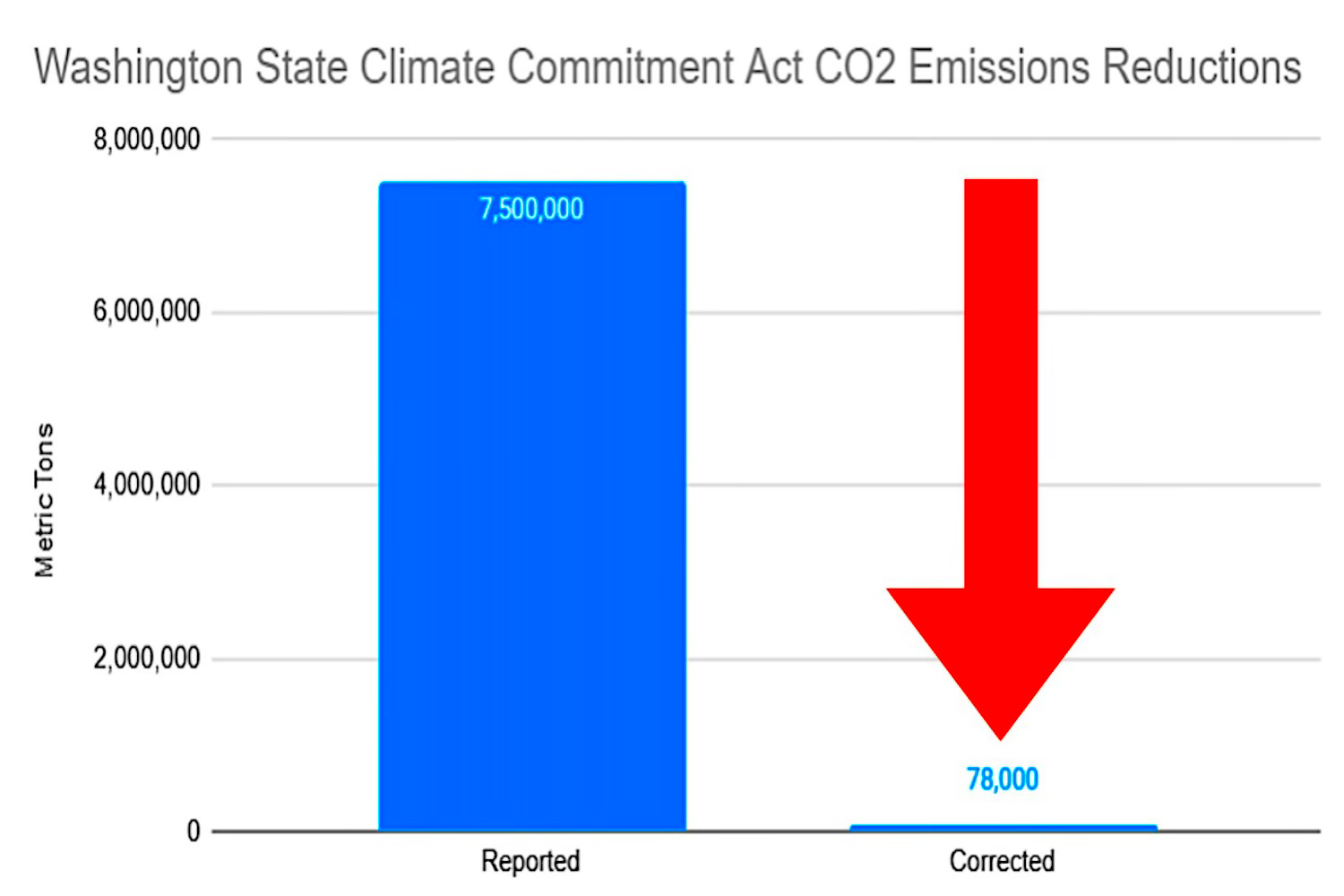
The Washington Policy Center caught the error. A report issued by Washington State said that it costs $40 to reduce one metric ton of carbon dioxide, whereas the state’s previous report had said that the cost was $1,400. This discrepancy caused the Center to investigate, where they found the eight projects with the accounting error. According to Todd Myers, vice president for research at the Washington Policy Center, the majority of projects funded by the carbon auctions were “simply irresponsible,” costing several times more than the benefits they provide.
The Climate Commitment Act
Washington’s goal is to reduce greenhouse gas emissions by 95% by 2050. To help reach that goal, in 2021, Washington Governor Jay Inslee signed the CCA, which requires the state’s largest emitters of greenhouse gases to purchase allowances for the emissions they release. The CCA caps the amount of emissions that entities can emit and requires them to purchase credits if they surpass that threshold. Governor Inslee stated the Act would only add pennies to the price of gas at the pump, but it ultimately added 40 to 60 cents per gallon. The CCA also drove natural gas and electricity prices higher, with monthly energy bills escalating by 15-30%.
Funds from the CCA are so lucrative that state politicians want to use them to support other non-climate endeavors, such as lowering families’ sales tax payments and schools’ utility bills. Where the money goes has been a subject of debate. The 2024 state ballothad an option to recall the policy entirely, but it failed.
Other Fees
Washington State, like California, has a number of added fees that bring up the cost of energy — all in the name of combating climate change, which they believe means getting rid of fossil fuels. The Clean Fuel Standard (CFS) is a mandate on fuel suppliers to blend lower-carbon fuels or buy credits. It is estimated to add an additional 19-cents per gallon by 2031 to gasoline prices and possibly raise diesel prices even more, fees that add to the cost of trucking, agriculture, manufacturing, and everyday goods that consumers must pay.
The state’s gas tax recently increased by six cents and is the third-highest gas tax in the nation at 59 cents per gallon. The diesel tax increased by 12 cents. Families living in rural areas where there is no or limited public transit are affected more because they require transportation for every errand.
Combined, these fees — the CCA, CFS, and gas tax — add nearly $1 per gallon to the cost of gasoline. Washington State’s gasoline price ranks third highest in the nation after Hawaii and California at $3.79 per gallon, 33% higher than the national average.
Analysis
Whether due to deception or incompetence, Washington drastically overestimated the emissions-reducing effects of the CCA. However, the climate change effects of the program and the state’s other taxes and mandates are of little concern to the state’s politicians compared to their contributions to state revenues.
With more money in the state budget, they can use the program as a method for funding politically favored social programs.
If Washington really wants to reduce emissions, it could pursue new natural gas generation, which has played the largest role in emissions reductions across the country.
For inquiries, please contact wrampe@ierdc.org.
#WashingtonState #Washington #Emissions #GreenEnergy #NaturalGas #IER

Can Democrat Governors Ignoring Global Realities, that Cling to “Green” Policies, explain how wind turbines or solar panels will make the more than 6,000 products in our daily lives that did not exist before the 1900’s, and the fuels to move the heavy-weight and long-range needs of more than 50,000 jets moving people and products, and more than 50,000 merchant ships for global trade flows, and the military and space program?
The only actual climate dangers are global cooling and CO2 starvation, while the eco-commies wage war on CO2 to try to make the planet colder.
The actual external value of CO2 is positive. The eco-commies pretend it's negative in order 1) to destroy the capitalism/freedom that they hate and 2) to divert taxpayer money to themselves.