
Refinery Closures, Pipeline Issues, and A 65% Drop in Oil Production Have Put California “On the Brink of A Cascading Fuel Supply Failure”
Guest Post by Kyle Kohli from Energy In Depth California.
If you’re a driver in the Golden State, watch out.
California could be months away from what a new analysis from USC and UC Berkeley professors describe as the most severe breakdown of the state’s fuel infrastructure in modern history.
The new report released this week, California’s Oil and Gasoline Conundrum: A Blueprint to Address California’s Gasoline Insecurity, High Prices and Avert More Pipeline & Refinery Closures, warns that California is on track to lose up to 20 percent of its remaining refining capacity, face the shutdown of its largest northbound crude pipeline, and become so supply constrained that gasoline prices could double relative to the national average by the end of 2026.
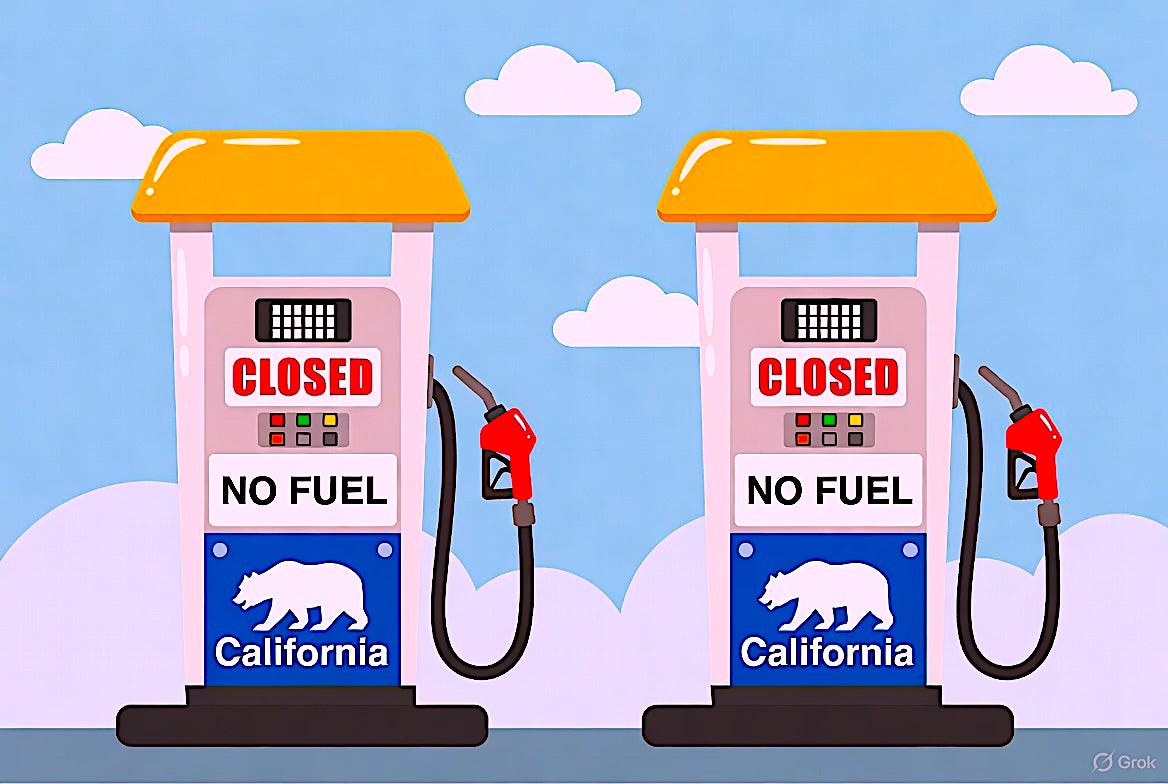
According to the authors ongoing refinery closures, collapsing pipelines, and a 65 percent drop in in-state oil production have placed California “on the brink of a cascading fuel supply failure” that will impact not just the state, but the entire west coast and even U.S. military installations.
As California Representative Vince Fong (CA-20) explained in his recent op-ed:
“By early 2026, the state is projected to lose nearly 20 percent of its remaining refining capacity, and without urgent action, blackouts, price spikes and fuel shortages will become the new normal – not only for Californians, but for millions across the West Coast who depend on our energy supply.”
Yet even as these crises mount, Gov. Gavin Newsom seems determined to ignore reality.
Recently at COP30 Newsom warned that the United States risks ceding the energy race to China. The irony? The new analysis makes clear that California has already ceded that race, because the Governor’s own decisions have gutted in-state production, crippled refineries, and made the state increasingly dependent on foreign fuel supplies.
Newsom Policies Made California Dependent on Chinese Energy
What Newsom conveniently omitted from his remarks in Brazil is that California’s fuel supply, including jet fuel, is already being propped up by Chinese refiners and tankers. In 2024, according to the new paper, the majority of California’s imported jet fuel came from China, routed through the Port of Los Angeles. And as California’s refineries go dark, Chinese, Indian, and Middle Eastern producers have rapidly stepped in to fill the void:
“To compensate for the imbalance in demand (consumption) and in-state production of gasoline, California has been forced into importing tens of millions of barrels of refined products from refineries in China, India, Saudi Arabia, and South Korea, demonstrating the state’s ongoing and growing vulnerability to supply disruptions, geopolitical unrest, weather, labor disruptions, vessel availability, and foreign dependence.”
The report bluntly warns that California is increasingly reliant on overseas refined products, especially from Chinese-owned or controlled supply chains. And importantly, the authors argue these are not climate friendly imports, something Gov. Newsom explicitly acknowledged years ago.
Back in 2020, as Energy in Depth documented, Newsom admitted that California’s shrinking in-state production was simply being replaced by foreign oil with a much higher carbon footprint:
“As it relates to managing decline, we’ve got to address the issue of demand. California since 1985 has declined its production by 60 percent, but we’ve only seen a modest decrease in demand by 4.4 percent. Sixty percent decline in production, but only a 4.4 percent decline in demand. And that means we are making up for a lack of domestic production from Saudi Arabia, Ecuador, and Colombia. And that’s hardly an environmental solution when you look globally.”
The new analysis confirms this remains just as true, but worse, in 2025. As the state shuts down refineries and pipelines, California is forced to import even larger volumes of crude and refined products from foreign suppliers with weaker environmental standards, all transported on tankers that contribute additional emissions.
Ironically, Newsom’s 2020 warning has come true, and actually accelerated, under the Governor’s own policies.
At the same time, California’s alternative energy infrastructure is also being built on Chinese solar panels, batteries, and critical minerals. While Newsom lectures about Beijing’s rising energy influence, he has tethered California’s energy system to supply chains dominated by China.
Those same policies, coupled with years of punitive actions against in-state oil and gas development have hollowed out California’s energy production capacity and pushed energy prices to record highs, making China the biggest beneficiary of Newsom’s crusade against fossil fuel.
Newsom’s Hostility to California Refiners Risks American National Security
Perhaps the most alarming finding in the report is the growing risk to U.S. military readiness. California is home to over 40 military installations, all of which depend on reliable access to jet fuel and diesel.
As refineries close, the state is increasingly sourcing these fuels from Chinese and foreign suppliers, a move that horrifies national security experts. The report warns:
“Relying upon China for jet fuel in a national emergency, increased military operations, or the need to intervene on behalf of Taiwan would be highly precarious.”
In addition, California’s dependence on global markets opens the door to rogue regimes. The authors note that some Chinese refiners are processing crude from Iran and Venezuela, raising the disturbing prospect that California drivers are now indirectly financing hostile governments and cartels.
Newsom’s Kern County Reforms “Too Little and Too Late”
Under political pressure over high prices and looming shortages, Newsom reversed course on at least one front, backing SB 237 this fall, which allows up to 2,000 new drilling permits per year in Kern County starting in 2026.
But the authors are blunt about how limited that impact will be:
“SB 237 will add some production but not enough to offset the overall statewide decline and will not adequately stabilize the state’s petroleum infrastructure.” […]
“Even if Kern County issued all 2,000 permits, the impact on statewide crude supply would be modest and insufficient to reverse California’s structural decline.”
Similarly, Newsom and legislative leaders have touted AB 30, which expands sales of ethanol gasoline, as a way to shave 20 cents per gallon off prices. The report describes those savings claims as “overly optimistic” and “borderline unrealistic,” noting that the overwhelming driver of price pressure is lost refining capacity, not simply altering the blend-stocks.
What the Authors Say Must Happen
The authors argue that the state can still pull back from the brink, but only with decisive action that goes well beyond SB 237 and AB 30. They recommend:
Reopening the Las Flores Canyon pipeline system and restoring production in the Santa Ynez Unit, which they estimate could eventually supply up to 100,000 barrels per day of low-decline California crude suited to in-state refineries.
Using that coastal crude to free up more Kern County barrels for northern refineries, helping keep both refineries and the San Pablo Bay pipeline viable.
Prioritizing the preservation and restart of existing refineries.
They warn that failure to act will:
“Accelerate the exit of California refineries, increase global GHG emissions, force greater reliance on foreign suppliers, increase consumer prices, and diminish U.S. national security.”
BOTTOM LINE: California is barreling into an energy crisis driven by years of political hostility toward in-state oil, and a governor who warns about “ceding the energy race to China” while making his own state dangerously dependent on Chinese fuel and Chinese supply chains.
After years of attacking California’s energy producers, Newsom has delivered exactly what he once warned about: higher emissions, deeper dependence on foreign oil, and skyrocketing costs for consumers.
#EIDCalifornia #Energy #Newsom #KyleKohli #EnergyInDepth #California #California #Refineries #Pipelines #FuelSupply

California Governor Newsom has no solutions to how to run California’s economy without crude oil.
Newsom remains oblivious to economies’ demands for a supply chain of the products and transportation fuels currently derived from fossil fuels. He seems unaware that so-called renewables like wind and solar CANNOT make any products or fuels for society, as they can ONLY generate electricity under favorable weather conditions.
Supply chain of PRODUCTS and FUELS that wind and solar CANNOT support
Today, we’re a materialistic society. Wind and solar CANNOT make EV’s, or any of the products or fuels that get made from fossil fuels that support:
• Hospitals
• Airports
• Militaries
• Medical equipment
• Telecommunications
• Communications systems
• Space programs
• Appliances
• Electronics
• Sanitation systems
• Heating and ventilating
• Transportation - vehicles, rail, ocean, and air
• Construction - roads and buildings
• Nearly Half the World’s Population Relies on Synthetic Fertilizers Made from Fossil Fuels
More importantly, the greatest threat to humanity is running out of crude oil, and the refineries that process that that raw black tar, before we have an alternative to meet the supply chain of all the products and transportation fuels that are derived from oil that are supporting the 8 billion on this planet.
The rapid cessation of fossil fuel use, if followed through before we have an alternative replacement for the supply chain of products and fuels being demanded by society, is not just a policy misstep; it’s a death sentence for half the planet.
Supposedly California has a lot of smart tech people. Why do they keep voting for Newsom? How bad does it have to get before people rethink their politics?