
Don't Wave Your Climate Justifications for Christmas at Me!

Do you fear your Christmas tree, probably still up today, is having an impact on global warming? If you do, you need to get a life, of course, because the question is beyond silly and enters into the realm of the Kafkaesque. Yet, addressing such bizarre fears, is the sort of climate research financed by governments who are borrowing from our great-great-great-grandchildren to pay for it. It is, too, the stuff of junk science that so many feel they must pursue these days to show just how climate-friendly they are or their opposites aren’t.
What I'm talking about is a Time article from last Christmas. It was titled “How Climate-Friendly Is Your Christmas Tree?” and pondered this soul-searching question:
[T]his year, as I carefully unfurled the bound boughs of polyvinyl pine needles, I started wondering if I should go back to the real thing. Now that I’m a climate correspondent, I am much more aware of the impact of all my consumer decisions on our planet. It’s hard to imagine something less sustainable than a plastic Christmas tree that’s only used once a year.
Christmas in general is a high carbon emissions holiday, according to Paris-based carbon accounting firm Greenly. This year the organization calculated that the typical U.S. Christmas celebration at home is responsible for 750 kg of CO2—4.6% of a family’s annual emissions and 14 times as much as a typical evening. Gifts, especially electronics, are responsible for most of the emissions, followed by the typical meat-and-alcohol heavy meal. (European family Christmases have a lighter footprint, emitting 400 kg of CO2, largely because they give less extravagant gifts.) The tree and decorations clocked in at 2.6% of total U.S. household Christmas emissions—that comes out to 19.5 kg of carbon emissions. This may not seem like very much—the equivalent of a couple of hamburgers—but in the spirit of gifting to the planet, is there a way to make a more sustainable choice, aside from the climate-scrooge option of doing nothing at all?
The rest of the article reviewed some research on the question. This research was commissioned by the American Christmas Tree Association (ACTA). The author naively suggests the ACTA “is real vs. artificial tree agnostic” but later also notes the “the C.E.O. of Balsam Hill, an artificial tree company” is one of its founders. So, we know the research has a built in bias.
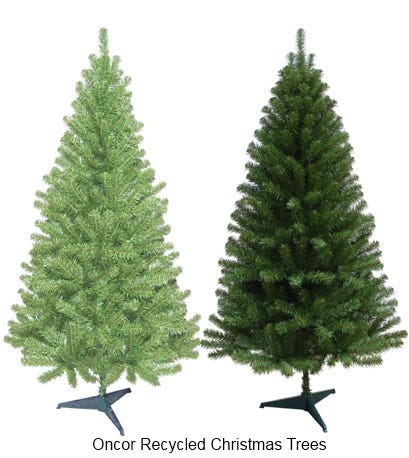
Nonetheless, the researchers from WAP Sustainability Consulting, LLC managed to generate 46 pages of academic gobbledygook on the subject with this predictable result:
Given the quantification of environmental impacts across both of the trees’ life cycles, a comparative assertion shows the breakeven point between the two trees is 4.7 years. That is to say an artificial tree purchased and used for at least 4.7 years demonstrates a lower contribution to environmental impact than 4.7 real Christmas trees purchased over 4.7 years. This assertion considers all end of life scenarios for the real Christmas tree, and assumes that a customer of an artificial tree would purchase the tree and keep it for 5 or more years. The breakeven point can change based on the environmental metrics and end-of-life scenarios, but considering the most conservative calculations, purchasing an artificial tree and keeping it for 4.7 years is less environmentally impactful than purchasing the equivalent amount of real Christmas trees.
Keep your artificial tree for more than five years, in other words, which most obviously do, and it will be more climate-friendly than the five live Christmas trees you would have used in the alternative. Surprise, surprise. Fortunately, this research was apparently financed by the artificial tree industry and not taxpayers. But, that’s not the point.
No, the point is the silliness of having to argue over the climate impacts of Christmas trees. Christmas is a celebration of the light in our lives and the very idea of having to justify not wanting to live in the dark to climate obsessed grifters and ideologues is obnoxious, whoever may pay for it. Sadly, though, we see this nonsense everywhere we look. Studies about the climate impacts of our own breathing, for instance, are among the latest and reveal the anti-human nature of the whole global warming campaign, but that’s a deeper subject for another day. For now, don’t wave your climate justifications for Christmas at me!
#Christmas #Trees #ArtificialTrees #Climate #GlobalWarming

A couple of decades ago, our provincial government sponsored a program where you could drop off your strings of incandescent Christmas lights and receive LED lights in exchange, all in the name of reduced electricity consumption and saving the planet.
I hung on to my incandescent strings, and passed some along to the children. We are all still using them.
Meanwhile, my son-in-law tells me that his neighbour buys new LED outdoor Christmas lights every year, because they generally only last the one season.
Astonishing that people receive a paycheck to analyze the CO2 footprint of Christmas.