
Cloud Seeding Is Junk Science. Playing God Is Tough. The Lesson for the Climate Cult? Peer Review Is No Substitute for Skepticism.

The following is from a detailed, but very readable, post at Judith Curry’s Climate, etc. site. Read the whole thing! It’s just excellent!
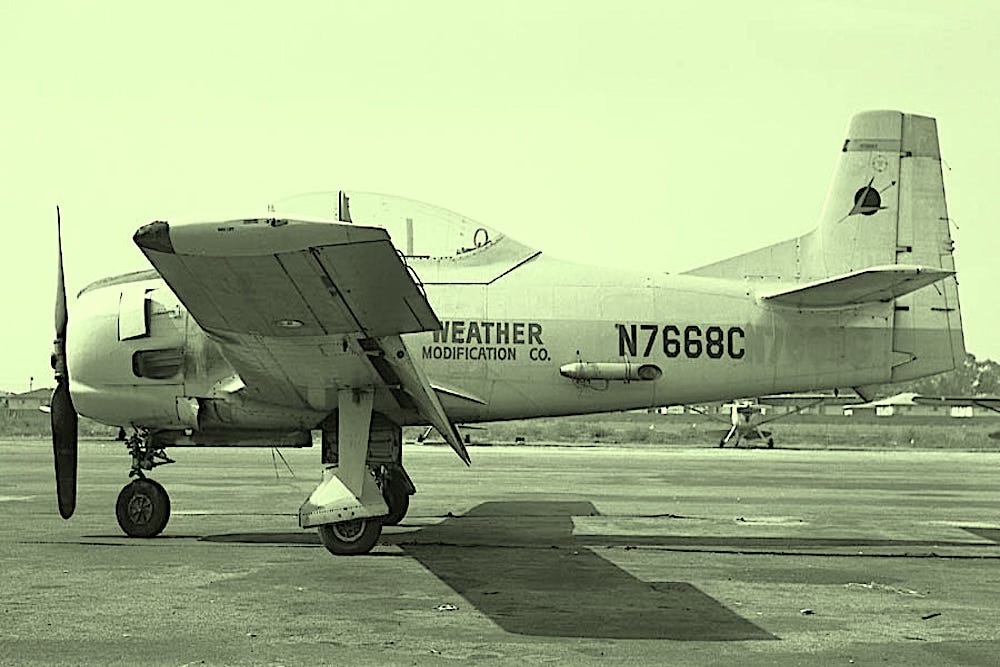
How we fooled ourselves about the effectiveness of cloud seeding.
The Colorado River Basin Pilot Project (CRBPP, 1970-75) is still the most ambitious, expensive randomized orographic cloud seeding project in US history. It featured an unprecedented amount of instrumentation, including up to 87 recording gauges, telemetered high-altitude weather stations, some above the tree line, telemetered seeding generators, radars, and, later, aircraft measurements. The target area in the San Juan Mountains of SW Colorado was over 1200 square miles (~3100 km2). Avalanche hazards and snowpack were closely monitored, with additional support from the Soil Conservation Service and the US Geological Survey.
An independent contractor who did not know whether days were seeded or not, measured precipitation. Simultaneously during the CRBPP, research was underway due to a separate million dollar grant to explore possible ecological impacts of the extra snow that was expected to be produced and the possible effects of silver iodide being used to seed.
The CRBPP aimed to demonstrate at a high level of competence that cloud seeding could increase snowfall on a determinant basis. It was going to be the centerpiece of all the Bureau of Reclamation’s cloud seeding efforts, one even having its own documentary film, “Mountain Skywater,” a testimony to the CRBPP’s perceived importance. Obtaining a statistically significant result that seeding had increased snowfall would then support widespread operational seeding after the CRBPP to address looming water shortages in the West.
The CRBPP’s foundation mainly rested on a single, spectacular report of increases (50-100%) in snow produced by cloud seeding obtained in a four and a half season randomized experiment at Climax, CO, (“Climax I”) conducted by Colorado State University (CSU) scientists, hereafter, “the experimenters”).
By 1969, preliminary reports indicated that equally as spectacular large percentage increases in snowfall as had occurred in Climax I were accruing in a second, “confirmatory” randomized experiment at Climax (“Climax II”), and from a separate, seasonally randomized one targeting Wolf Creek Pass in southwest Colorado. In all these experiments including the ongoing ones, statistically significant snow increases were linked to same meteorological conditions; high temperatures in the mid-troposphere (>-20°C or –>-23°C at 500 hPa).
With the Climax I results in hand, and with the promising preliminary results from the two other experiments, the Bureau of Reclamation’s cloud seeding research division funded the design of the CRBPP to CSU scientists and their consultants in June 1968.
The two on-going experiments finished in 1970, the same year that the first random decisions were drawn in the CRBPP. The statistical results of the newly completed experiments were nearly identical with those in the Climax I experiment and were compatible with the preliminary results.
In the meantime, a key report on ice crystal concentrations and ice nuclei at Climax appeared in 1968 indicating there were too few ice nuclei to produce natural snow in clouds with top temperatures >-20°C. It was asserted by the experimenters that high 500 hPa temperatures had partitioned increases in snowfall because wintertime storm cloud tops hovered around 500 hPa. The 1968 report seemed to explain why had worked with high 500 hPa temperatures. It was when those temperatures were >-20°C that the large percentage increases in snowfall occurred on seeded days. A leap had been made.
Further cementing the view about where cloud tops resided was that in all three experiments, the water equivalent precipitation per experimental day dropped precipitously as 500 hPa temperatures rose above -20°C on the control days, but not on the seeded days where the daily amount continued to rise, presumably due to seeding. Confidence was thus further instilled that the temperature at hPa 500 really had captured those at cloud top; the declining amounts of snowfall on control days represented clouds that were ineffective precipitators due to a lack of ice crystals and needed to be seeded.
The final, convincing proof, again, in all three experiments was that cloud seeding had increased the length of time that snow fell and not its intensity. Snow fell for longer periods at the same intensity as natural snowfall on seeded days, a finding compatible with seeding from ground generators using small amounts of silver iodide as was the case in all these experiments. The inference was made that a thick, non-precipitating cloud layer must exist before and after natural snowfall events and that those had been made to snow.
At this point, the reader can perhaps understand why, during the several major planning conferences held by the CRBPP sponsor, the Bureau of Reclamation’s Division of Atmospheric Water Resources Management, that there was no questioning of the underlying foundations of the Colorado experiments; they all fit together so well.
Thus, a great edifice of statistical results with a supporting physical foundation that explained why increases in snowfall had occurred gave confidence that cloud seeding had been proved by the CSU experiments. A scientific consensus formed, validated by the National Academy of Science-National Research Council’s Panel on Weather and Climate Modification who wrote in 1973, ironically, as the CRBPP was plummeting into statistical failure:
“Hence, in the longest randomized cloud-seeding project in the United States (at Climax, CO), involving cold orographic winter clouds, it has been demonstrated that precipitation can be substantially increased and on a determinate basis.”
A newspaper article starts a downhill slide
After a November 1975 newspaper article that began on the front page of the Durango Herald in which a CRBPP meteorologist announced that he was going to reanalyze all the CSU experiments, the “wheels of success” began to fall off the CSU experiments immediately. The experimenters themselves decided to review their experiments (again) after the article came out. It’s quite bad if an outsider finds your errors before you do.
By 1977 the experimenters were acknowledging that, remarkably, both Climax experiments had enjoyed, “lucky random draws” in the category where the huge (50-200%) percentage increases in snowfall had been reported, the very reports that spurred the funding of the CRBPP. The huge percentage increases in snowfall were due to natural storms that were heavier on the seeded days than the control days in the high temperature category. The results of both Climax experiments were verbally retracted at the 7th Conference on Planned and Inadvertent Weather Modification at Banff in 1979.
At that same conference this writer showed that the seasonally randomized Wolf Creek Pass experiment (WCPE), had also enjoyed a “lucky random draw” that created the misperception of large percentage increases in snowfall and statistically significant increases in runoffs. The CRBPP was situated in San Juan Mountains of southwest Colorado due to the apparent success of the WCPE and its heavier warm storms compared to those at Climax.
On a remarkable evening at Banff in October 1979, ALL the successes reported by the experimenters on which the CRBPP had been based were swept away.
Airborne measurements by the University of Washington and the University of Wyoming late in the CRBPP found several critical problems, the most critical one being that ice crystal concentrations were far higher in clouds with high cloud top temperatures than had been reported in 1968 by the experimenters, making the clouds largely unsuitable for cloud seeding. The primary pillar supporting the seeding successes had been removed.
Another cycle of reanalyses was to occur in the following years by the experimenters looking to resuscitate their lost cloud seeding successes, and by external skeptics who countermanded the that work. Ultimately, the view that there had been no cloud seeding induced increases in snowfall in any of the CSU experiments prevailed (with rare exception) when the dust settled by 1995.
How could our best scientists, and not just the NAS-NRC Panel on Weather and Climate Modification, be so fooled by ersatz cloud seeding successes backed by equally ersatz experimenter “ripe for seeding” cloud reports?
Answer: The ersatz reports made it into peer-reviewed literature.
#CloudSeeding #Climate #Snow #Rain #Colorado #CRBPP

How could they miss or be persuaded?
Corrupt morals to accept money for the desired outcome politicians wanted - simply selling ‘research’ to the politicians funding the project. Junk science is not new, just more prevalent and highly advertised today to make it more popular.